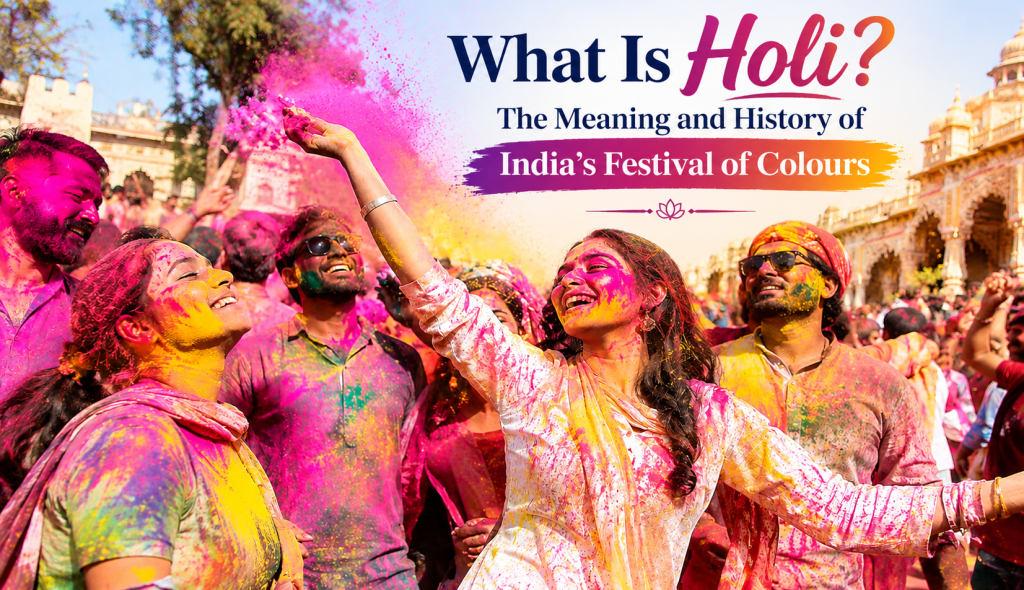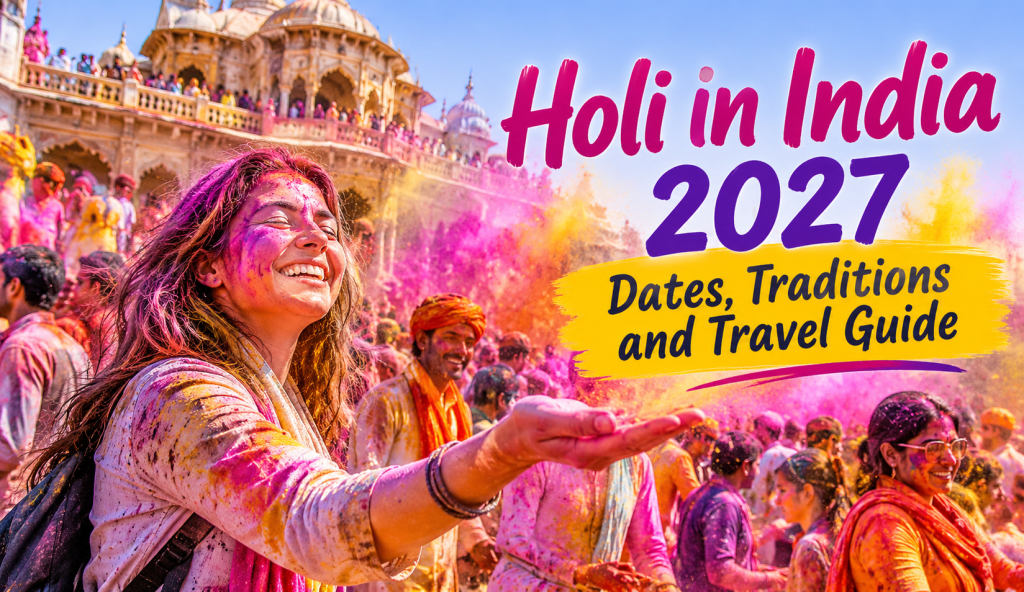
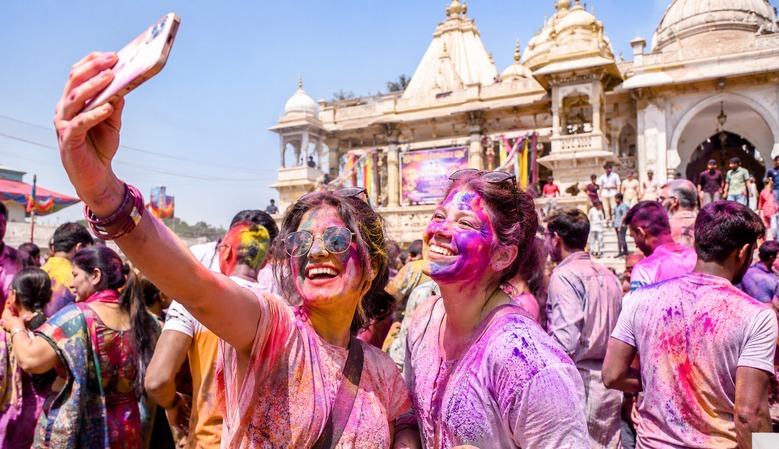
Imagine a spring afternoon filled with colourful powder, lively music, dancing and people celebrating together. You might experience this at a Holi festival in London, New York, Toronto or Sydney. But travel to India during Holi, and you will discover something more deeply connected to the country’s traditions, mythology, regional cultures and community life.
Holi in India is more than a festival of colours. It is a celebration of the arrival of spring, the victory of good over evil, the love of Radha and Krishna, and the joy of bringing people together. While international celebrations capture the excitement of colours and music, the festival in India also carries centuries-old religious and cultural traditions.
So, what makes Holi in India different from celebrations abroad? The biggest difference lies in the cultural setting, traditional rituals, regional customs, food and the way communities participate in the festival.
Whether you have already attended a Holi event in your home country or are planning your first trip to India, understanding these differences can help you appreciate the festival beyond its colourful appearance.
How Is Holi Celebrated in India?
Holi is one of India’s most widely recognised festivals, celebrated by Hindu communities and enjoyed by people from different backgrounds. It generally falls in February or March, on the full moon of the Hindu lunar month of Phalguna, marking the transition from winter to spring.
Unlike many colour-themed events, traditional Holi celebrations in India often begin the evening before the main festival.
1. Holika Dahan: The Ritual Before Holi
The celebrations begin with Holika Dahan, a ceremonial bonfire held on the evening before the main day of Holi.
Families and neighbourhood communities gather around the fire, perform traditional rituals and offer prayers. The ceremony recalls the story of Prahlad and Holika, symbolising the victory of good over evil. It also represents the symbolic burning away of negativity and the beginning of something new.
2. Playing with Gulal and Coloured Water
The following day, known as Rangwali Holi, is when streets, courtyards and neighbourhoods become filled with colours.
People apply gulal, a coloured powder traditionally used during Holi, to each other’s faces. Water-filled balloons, water guns known as pichkaris, music and dancing are also part of many celebrations.
Friends, relatives and neighbours greet each other with the familiar expression “Holi Hai!”
3. Family Gatherings and Community Celebrations
Holi is also an occasion for reconnecting with people. Families visit relatives, friends exchange greetings, and neighbours come together to celebrate.
In many communities, people apply colours to elders as a gesture of respect before joining the festivities. The festival provides an opportunity to put aside differences, renew friendships and strengthen social connections.
4. Traditional Food and Festive Hospitality
Food is another important part of the Indian Holi experience.
Some popular festive delicacies include:
-
Gujiya: A sweet, crescent-shaped pastry filled with a mixture of khoya, nuts and sugar.
-
Thandai: A traditional chilled milk-based drink flavoured with nuts and aromatic spices.
-
Malpua: A sweet pancake, often served with syrup.
-
Dahi Bhalla: Soft lentil dumplings served with yoghurt and chutneys.
These dishes reflect the festive hospitality associated with Holi. Recipes and food traditions vary between regions and households.
How Are Holi Celebrations Abroad?
Holi celebrations abroad have become increasingly popular, particularly in countries with Indian communities and international audiences interested in Indian culture.
In places such as the United States, United Kingdom, Canada, Australia and several European countries, Holi-inspired events are organised by cultural associations, universities, community groups and private event organisers.
These celebrations often bring together people from different nationalities who want to enjoy the colours, music and social atmosphere of the festival.
Some common features include:
-
Community colour festivals: Participants gather in public spaces or event venues to play with coloured powder.
-
Music and dance: DJs, Bollywood music, live performances and dance sessions create an energetic atmosphere.
-
University celebrations: Student associations and cultural societies organise Holi events to introduce international students to Indian traditions.
-
Cultural programmes: Some events include Indian food, traditional performances, dance workshops and cultural activities.
-
Family-friendly gatherings: Organisers may arrange designated spaces for children and families.
However, international celebrations are not all the same. Some focus on religious and cultural traditions, while others are primarily social events inspired by the Festival of Colours.
For many members of the Indian diaspora, these gatherings also provide an opportunity to maintain cultural connections and share their traditions with the wider community.
The key difference is not that one celebration is more meaningful than another. It is that Holi abroad is often experienced in a multicultural or organised-event setting, whereas Holi in India is closely connected to local traditions and seasonal festivities.
Holi in India vs Holi Abroad: 7 Key Differences
If you have attended a colour festival in your home country, you may already recognise the music, coloured powder and dancing associated with Holi. However, experiencing the festival in India introduces several additional cultural dimensions.
Here are seven important differences.
| Aspect | Holi in India | Holi Celebrations Abroad |
|---|---|---|
| Cultural significance | Closely connected to Hindu mythology, spring and traditional beliefs | Often introduces Indian culture through a multicultural celebration |
| Traditional rituals | Holika Dahan and regional religious customs are observed in many communities | Rituals may be included depending on the organiser and community |
| Community participation | Celebrated through families, neighbourhoods, temples and local gatherings | Often organised by cultural associations, universities and event organisers |
| Regional diversity | Different states and communities have distinctive Holi traditions | Celebrations generally reflect local Indian communities and event formats |
| Food and hospitality | Traditional sweets, homemade food and family gatherings are common | Indian food may be available at selected community events |
| Duration and style | Can range from a single main celebration to several days of regional festivities | Often organised as a scheduled event lasting a few hours or a day |
| Cultural setting | Experienced alongside India’s local heritage, religious traditions and everyday community life | Experienced within the cultural and social environment of the host country |
1. Cultural and Religious Significance
In India, Holi is closely associated with stories from Hindu mythology, particularly Prahlad and Holika and the love of Radha and Krishna. Abroad, the festival may be presented more broadly as a celebration of colour, happiness and togetherness.
2. Traditional Rituals and Customs
Holika Dahan is an important part of celebrations in many Indian communities. International events may include a bonfire ceremony or cultural programme, but this depends on the organisers and local arrangements.
3. Family and Community Participation
In India, Holi often extends beyond a ticketed event. Families, neighbours, friends and local communities participate in different ways. Abroad, participation frequently takes place through organised community gatherings.
4. Regional Diversity
India offers a remarkable variety of Holi traditions, from the Krishna-inspired celebrations of Braj to Basant Utsav in West Bengal. International celebrations may incorporate selected traditions depending on the cultural backgrounds of their organisers.
5. Traditional Food and Hospitality
Homemade gujiya, thandai and other regional delicacies are an important part of many Indian celebrations. Abroad, food arrangements vary according to the scale and nature of the event.
6. Duration and Style of Celebrations
While many international colour festivals take place over a few hours, Holi festivities in certain Indian destinations begin days before the main festival. Mathura, Vrindavan, Barsana and Nandgaon are notable examples.
7. Connection with Local Culture and Heritage
In India, Holi can be experienced alongside historic temples, traditional music, local markets, regional architecture and seasonal customs. This connection between a festival and its geographical setting adds another dimension to the travel experience.
The Cultural and Religious Significance of Holi in India
To understand what makes Holi in India different, it is important to explore the stories and beliefs behind the festival.
Holi is associated with several traditions, and its significance is not identical across every Indian region. Three important themes help explain its cultural importance.
The Story of Prahlad and Holika
One of the best-known stories behind Holi comes from Hindu mythology.
According to the legend, King Hiranyakashipu wanted everyone to worship him. However, his son Prahlad remained devoted to Lord Vishnu. Angered by his son’s devotion, the king attempted to punish him.
He eventually asked his sister Holika, who was believed to possess protection against fire, to enter a blazing fire with Prahlad. However, Prahlad survived while Holika was consumed by the flames.
This story is remembered through Holika Dahan, symbolising the victory of good over evil and the power of faith.
The Love of Radha and Krishna
Holi also has a special connection with Lord Krishna, particularly in the Braj region of Uttar Pradesh.
According to a popular tradition, young Krishna was concerned about the difference between his dark complexion and Radha’s fair complexion. His mother, Yashoda, playfully suggested that he apply colour to Radha’s face.
Krishna followed her suggestion, and this playful tradition became associated with the colourful celebrations of Holi.
This is one reason why Mathura, Vrindavan, Barsana and Nandgaon are especially famous for their Holi festivities.
Spring, Renewal and Togetherness
Beyond religious stories, Holi welcomes the arrival of spring and the changing seasons.
It is traditionally associated with new beginnings, happiness, forgiveness and stronger relationships. People meet friends and relatives, exchange greetings and, in many communities, use the occasion to move beyond past disagreements.
These themes help explain why Holi remains an important cultural celebration for generations of Indians.
For a deeper understanding of the festival, read our guide on What Is Holi? to learn about its meaning, history and traditions.
Where Can International Travellers Experience Holi in India?
One of the most exciting aspects of planning a Holi trip is choosing the destination. Different parts of India offer different experiences, from traditional temple celebrations to colourful city gatherings.
Here are some destinations worth considering.
1. Mathura and Vrindavan – Experience Krishna’s Holi Traditions
Mathura is traditionally regarded as the birthplace of Lord Krishna, while Vrindavan is closely associated with his childhood stories.
Their Holi celebrations include temple gatherings, devotional music, flower celebrations and the application of gulal.
The Banke Bihari Temple in Vrindavan is particularly well known for its Holi festivities. Travellers can also explore the region’s historic temples and ghats.
2. Barsana and Nandgaon – Discover Lathmar Holi
Barsana and Nandgaon are famous for Lathmar Holi, a distinctive regional tradition associated with the stories of Radha and Krishna.
During this celebration, women playfully strike men with sticks, known as lathis, while the men use shields to protect themselves. The festivities are accompanied by traditional songs, colours and enthusiastic crowds.
This is one of the most distinctive Holi traditions in India and attracts visitors interested in regional culture.
3. Jaipur – Celebrate Holi Amid Rajasthan’s Heritage
Jaipur offers an opportunity to combine Holi celebrations with Rajasthan’s architectural and cultural attractions.
Visitors can explore the city’s historic forts, palaces, traditional markets and local cuisine while enjoying organised Holi events or community celebrations.
It is a suitable choice for travellers who want to combine a festival experience with a broader Rajasthan holiday.
4. Delhi – Enjoy a Modern City Celebration
Delhi offers a mixture of neighbourhood celebrations, cultural gatherings and organised Holi events.
International travellers can also explore historical landmarks, museums, food markets and the city’s diverse neighbourhoods during their visit.
Delhi can be a convenient starting point for a wider North India itinerary, including a journey to Mathura and Vrindavan.
Planning to visit during the festival? Explore our Holi tour package to discover travel options and plan your celebrations.
A practical note: Holi dates follow the Hindu lunar calendar, and individual temple and regional events can take place on different days. Crowds, entry arrangements and access restrictions may also change. Check local announcements and official arrangements before finalising your itinerary.
Why Should You Experience Holi in India at Least Once?
Attending a Holi event abroad can be a wonderful introduction to Indian culture. However, experiencing the festival in India allows you to understand how colours, traditions, religious stories and community life come together.
Here are a few reasons to consider adding Holi to your India travel plans.
-
Understand the stories behind the colours: Discover the traditions of Prahlad, Holika, Radha and Krishna in their cultural setting.
-
Experience Indian hospitality: Share traditional sweets, festive meals and greetings with local communities in appropriate settings.
-
Explore regional traditions: Witness how Holi changes across destinations, from the Lathmar traditions of Barsana to the spring celebrations of Shantiniketan.
-
Discover India’s heritage: Combine festival celebrations with visits to historic temples, forts, palaces and cultural landmarks.
-
Experience a different side of India: Festivals offer opportunities to understand local customs and community relationships beyond conventional sightseeing.
For international travellers, Holi can become a meaningful part of a wider Indian holiday rather than simply another event on the travel calendar.
Tips for Foreign Tourists Celebrating Holi in India
Holi is an exciting festival, but first-time international visitors should understand a few practical details before joining the celebrations.
1. Wear Comfortable Clothes
Choose inexpensive, comfortable clothing that you do not mind getting stained. White cotton clothes are traditionally popular because coloured powder stands out against them.
2. Protect Your Skin and Eyes
Use skin-friendly colours, preferably from reliable sources. Apply a suitable moisturiser before going out, protect your eyes and avoid rubbing colour into them. If colour enters your eyes, rinse gently with clean water.
3. Keep Your Valuables Secure
Leave unnecessary jewellery, expensive watches and valuable accessories at your accommodation. Carry only essential items in a secure bag.
4. Choose Comfortable Celebration Areas
If this is your first Holi in India, consider organised events, hotel celebrations or gatherings recommended by a reliable local guide. You can also enjoy the festivities as an observer without participating in every activity.
5. Respect Consent and Local Customs
Always ask before applying colours to someone. Not everyone wants to participate, and religious spaces may have specific rules. Respect people’s boundaries and follow local guidance.
6. Avoid Overcrowded Areas
Some popular Holi destinations attract very large crowds. Avoid pushing through congested streets, keep your group together and identify a meeting point in advance.
7. Plan Your Travel Early
Book accommodation and transport well ahead of the festival, especially for popular destinations such as Mathura and Vrindavan. Check the local festival schedule because celebrations may occur on different dates.
These simple precautions can help make your Holi experience more comfortable and enjoyable.
Conclusion: Holi in India Is More Than a Festival of Colours
Holi celebrations abroad offer a wonderful opportunity to enjoy Indian music, dance, colours and community spirit. However, Holi in India offers an additional cultural dimension through its mythology, traditional rituals, regional celebrations, festive food and local hospitality.
From the devotional atmosphere of Vrindavan to the distinctive Lathmar traditions of Barsana and the heritage-rich surroundings of Jaipur, every destination can offer a different perspective on the festival.
If you have already celebrated Holi in your home country, consider experiencing it in India to discover the stories and traditions behind the colours.
Planning your next cultural holiday? Explore IndiaTravel’s Holi tour package and discover opportunities to celebrate India’s Festival of Colours while exploring its heritage, traditions and destinations.
Frequently Asked Questions (FAQs)
1. What makes Holi in India different from Holi celebrations abroad?
Holi in India is closely connected to Hindu mythology, traditional rituals, regional customs and community celebrations. Abroad, many events focus on colours, music and cultural gatherings, although some also include religious ceremonies.
2. How is Holi traditionally celebrated in India?
Traditional celebrations begin with Holika Dahan, a bonfire ceremony held the evening before Holi. The following day, people apply gulal, play with coloured water, enjoy festive food and celebrate with family and friends.
3. Can foreign tourists participate in Holi celebrations in India?
Yes. International tourists can participate in public and organised Holi celebrations. It is advisable to choose comfortable settings, respect local customs, ask for consent before applying colours and follow local safety guidance.
4. Which is the best place to experience Holi in India?
Mathura and Vrindavan are excellent choices for Krishna-related traditions, while Barsana and Nandgaon are famous for Lathmar Holi. Jaipur and Delhi are alternatives for travellers interested in combining celebrations with sightseeing.
5. Is Holi celebrated in the same way across India?
No. Holi traditions vary by region. For example, the Braj region is known for Krishna-related festivities, Shantiniketan celebrates Basant Utsav, and Punjab observes the Sikh festival of Hola Mohalla around the same period.