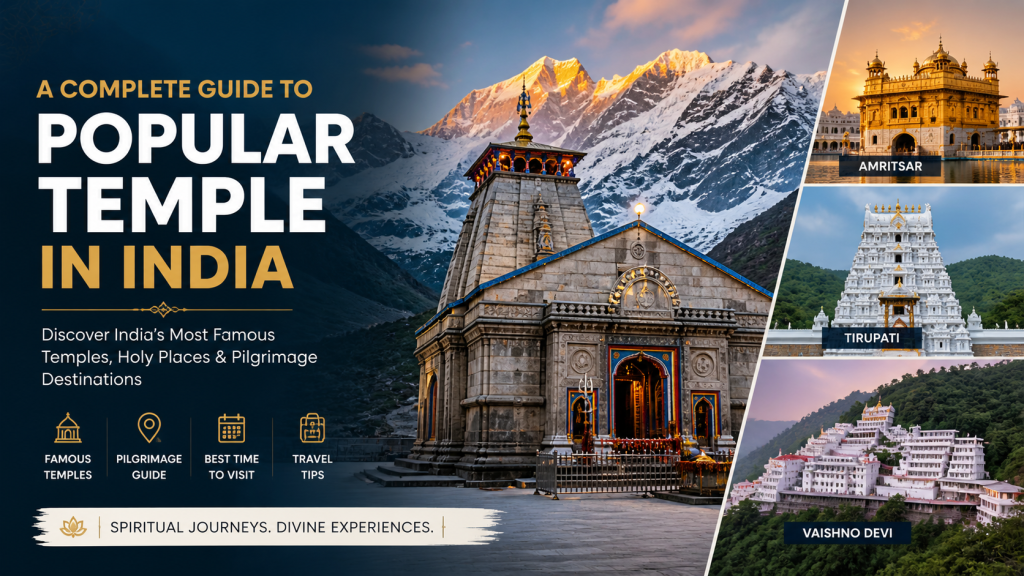
Searching for the most popular temple in India to add to your pilgrimage or travel list? India is not just a country, it is a living, breathing civilization where spirituality is woven into every stone, every river, and every sunrise. With over 2 million temples across the subcontinent, India holds the highest concentration of sacred sites on Earth. Yet among these, a select few popular temples in India stand apart, for their architectural grandeur, mythological significance, or the sheer energy of collective devotion that fills their courtyards.
In this guide, we cover the top popular temple in India, ranked by spiritual importance, visitor footfall, heritage value, and travel accessibility. From the Himalayas to the southern shores of Cape Comorin, this is your definitive 2026 temple travel roadmap.
Popular Temple in India: Complete Guide to Sacred Destinations
1. Vaishno Devi Temple, Jammu & Kashmir
Overview
Nestled in the Trikuta Mountains at an altitude of 5,200 feet, the Vaishno Devi Temple is one of the most popular temple in India by sheer visitor count, welcoming over 8 million pilgrims annually. Dedicated to Goddess Vaishno Devi (a manifestation of Shakti), this is one of the 108 Shakti Peethas of India.
What Makes It Special
• The 14 km trek from Katra to the cave shrine is itself a spiritual experience
• The holy cave houses three natural rock formations (Pindis) representing Maha Kali, Maha Lakshmi, and Maha Saraswati
• Helicopter services available from Katra for senior pilgrims
• The Bhawan (main shrine) has been recently modernized without losing its sacred atmosphere
Practical Info
| Attribute | Details |
| Location | Katra, Reasi District, J&K |
| Deity | Goddess Vaishno Devi (Shakti) |
| Best Time to Visit | March–May & September–November |
| Annual Visitors | ~8 million+ |
| Trek Distance | 14 km (one way) from Katra |
2. Tirupati Balaji Temple (Sri Venkateswara Temple), Andhra Pradesh
Overview
The Sri Venkateswara Temple in Tirupati is arguably the richest and most visited temple on Earth. Located atop the Tirumala Hills, it receives 60,000–100,000 devotees every single day. Dedicated to Lord Venkateswara (a form of Vishnu), this Dravidian-style temple is the beating heart of Vaishnavism.
What Makes It Special
• The temple’s annual revenue exceeds Rs. 3,000 crore — making it the wealthiest religious institution globally
• The iconic practice of hair tonsure (Murukan) draws millions who offer their hair as a sacred vow
• The famous Tirupati Laddu prasad has a GI tag and is recognized worldwide
• The Gopuram (gateway tower) stands 53 meters tall, adorned in gold plating
• Brahmotsavam — the 9-day grand festival — is one of India’s largest religious events
Practical Info
| Attribute | Details |
| Location | Tirumala, Tirupati, Andhra Pradesh |
| Deity | Lord Venkateswara (Vishnu) |
| Best Time to Visit | September–February |
| Daily Visitors | 60,000–100,000 |
| Darshan Options | Special Entry, Sudarshana Token, Free Darshan |
3. Kashi Vishwanath Temple, Varanasi
Overview
If there is one temple that embodies the soul of India, it is the Kashi Vishwanath Temple on the banks of the Ganga in Varanasi. One of the 12 Jyotirlingas (sacred abodes of Lord Shiva), this temple has been a center of spiritual learning and pilgrimage for thousands of years. The newly constructed Kashi Vishwanath Corridor (2021) has dramatically transformed the pilgrimage experience.
What Makes It Special
• One of the 12 Jyotirlingas — considered the holiest Shiva temple in Hinduism
• The Kashi Vishwanath Corridor now connects the temple directly to the Ganges Ghat
• Evening Ganga Aarti at Dashashwamedh Ghat nearby is a transcendental experience
• Varanasi itself is considered the city of moksha (spiritual liberation)
• The temple’s golden spire is plated with over 800 kg of gold
4. Golden Temple (Harmandir Sahib), Amritsar
Overview
The Golden Temple in Amritsar is not just popular — it is transcendent. The holiest shrine of Sikhism, the Harmandir Sahib welcomes 100,000+ visitors daily, making it one of the most visited religious sites in the world — surpassing even many international landmarks. Its breathtaking golden facade reflecting on the sacred Amrit Sarovar (Pool of Nectar) is an image that stays with you forever.
What Makes It Special
• Open to all faiths, religions, and backgrounds — no discrimination of any kind
• The Langar (community kitchen) serves free meals to 100,000 people every single day
• The temple is covered in 750 kg of pure gold donated by Maharaja Ranjit Singh
• The Palki Sahib ceremony — where the Guru Granth Sahib is brought in a golden palanquin — is deeply moving
• The Akal Takht, the highest temporal seat of Sikh authority, stands adjacent
5. Somnath Temple, Gujarat
Overview
Somnath is the first of the 12 Jyotirlingas and one of the oldest and most significant temples in Indian history. Destroyed and rebuilt 17 times across millennia — by invaders, natural disasters, and time — Somnath stands as an undying symbol of Hindu resilience and faith. Its location at the meeting of three seas (Triveni Sangam) on the Saurashtra coast makes it geographically and spiritually unique.
What Makes It Special
• First Jyotirlinga — mentioned in ancient texts like the Rig Veda and Shiva Purana
• The temple faces the ocean, and according to mythology, no land exists between Somnath and Antarctica in this direction
• The Sound & Light show at Somnath narrates 5,000 years of history with dramatic flair
• Sardar Vallabhbhai Patel spearheaded the current temple’s reconstruction in 1947 as a symbol of national pride
6. Meenakshi Amman Temple, Madurai
Overview
The Meenakshi Amman Temple in Madurai is South India’s crowning architectural jewel. A sprawling 17-acre complex with 14 magnificent gopurams (gateway towers) adorned with 33,000 intricately carved sculptures, this temple to Goddess Meenakshi (Parvati) and Lord Sundareswarar (Shiva) is a UNESCO World Heritage Site nominee and a living, functioning city within a city.
What Makes It Special
• Considered one of the Seven Wonders of India in various polls
• The Thousand Pillar Hall houses a museum of breathtaking Dravidian sculpture
• Chithirai Festival (April–May) celebrates the celestial wedding of Meenakshi and Shiva — drawing over 1 million visitors
• The tallest gopuram stands 52 meters — visible from across the city
• A functioning temple with over 15,000 daily visitors and elaborate daily rituals
7. Kedarnath Temple, Uttarakhand
Overview
At 3,583 meters above sea level in the Garhwal Himalayas, Kedarnath is among the most dramatic temple destinations in the world. One of the 12 Jyotirlingas and the highest of the Char Dham sites, Kedarnath can only be reached by a 16 km trek through breathtaking mountain terrain. The temple, believed to be over 1,000 years old, was built by the Pandavas and restored by Adi Shankaracharya.
What Makes It Special
• The highest Jyotirlinga — its remote location makes the pilgrimage deeply transformative
• The temple survived the catastrophic 2013 Uttarakhand floods almost miraculously — a massive boulder deflected the floodwaters
• Adi Shankaracharya attained samadhi near the temple — his samadhi sthal lies behind the shrine
• Helicopter services operate from Phata, Guptkashi, and Sirsi for senior or differently-abled pilgrims
• Open only from May to November due to extreme winter snowfall
8. Jagannath Temple, Puri, Odisha
Overview
The Jagannath Temple in Puri is one of the Char Dhams (four sacred pilgrimage sites) and one of the most mystically revered temples in India. Dedicated to Lord Jagannath (a form of Vishnu/Krishna), this 12th-century temple is famous for its Rath Yatra — the chariot procession that inspired the English word ‘juggernaut.’
What Makes It Special
• Rath Yatra (June/July) sees 1–2 million devotees pulling massive wooden chariots — one of the world’s largest human gatherings
• The Mahaprasad served here is considered sacred and cooked for 10,000 people daily in the world’s largest temple kitchen
• Non-Hindus are not permitted inside — making the view from Raghunandan Library rooftop across the street a popular alternative
• The flag atop the temple’s spire always flutters against the wind — an unexplained phenomenon
• The Sudarshana Chakra (wheel) atop the temple is visible from any direction in the city
9. Ram Temple (Shri Ram Janmabhoomi Mandir), Ayodhya
Overview
The Ram Temple in Ayodhya is the newest addition to India’s list of iconic temples — and already one of its most visited. Consecrated in January 2024, the temple is built at the site believed to be the birthplace of Lord Ram (Ramjanmabhoomi). Its stunning Nagara-style architecture, built in Rajasthan’s pink sandstone, represents one of India’s most significant cultural and religious milestones of the 21st century.
What Makes It Special
• Built on the Ramjanmabhoomi site — one of the most historically contested and sacred sites in India
• The temple received 150,000+ visitors on its very first day of opening to the public
• The architecture follows ancient Nagara shikhar style with 5 mandapas and 3 floors
• Ayodhya has been completely reimagined with new airports, ghats, and heritage corridors
• The idol of Ram Lalla in the garbhagriha is a 51-inch black stone murti of extraordinary craftsmanship
10. Siddhivinayak Temple, Mumbai
Overview
In the heart of the nation’s financial capital, the Siddhivinayak Temple in Prabhadevi, Mumbai, is the city’s most beloved and visited religious site. Dedicated to Lord Ganesha, this temple attracts industrialists, Bollywood stars, politicians, and everyday devotees with equal fervor. Tuesdays see serpentine queues stretching for hours, with visitors believing a darshan here fulfills one’s wishes.
What Makes It Special
• One of the wealthiest temples in Maharashtra with a trust valued at crores
• The temple’s idol has a unique trunk curved to the right (Siddhi Vinayak) — extremely auspicious
• Daily prasad is prepared in the temple’s own kitchen and distributed to thousands
• Celebrities and political figures are regular visitors — making it a modern cultural landmark as much as a religious one
• The gold-plated shikhar (spire) and the wooden door carved with scenes from the Ashtavinayak trail are masterpieces
Comparison Table: Popular Temple in India at a Glance
| Temple | Location | Deity | Annual Visitors | Best Time |
| Vaishno Devi | J&K | Goddess Vaishno Devi | 8 million+ | Mar–May, Sep–Nov |
| Tirupati Balaji | Andhra Pradesh | Lord Venkateswara | 30 million+ | Sep–Feb |
| Kashi Vishwanath | Varanasi, UP | Lord Shiva | 7 million+ | Oct–Mar |
| Golden Temple | Amritsar, Punjab | Waheguru (Sikh) | 36 million+ | Oct–Mar |
| Somnath | Gujarat | Lord Shiva | 3 million+ | Nov–Feb |
| Meenakshi Amman | Madurai, TN | Goddess Meenakshi | 15,000/day | Oct–Mar |
| Kedarnath | Uttarakhand | Lord Shiva | 15 lakh+ | May–Jun, Sep–Oct |
| Jagannath | Puri, Odisha | Lord Jagannath | 3 million+ | Rath Yatra (Jul) |
| Ram Temple | Ayodhya, UP | Lord Ram | 150,000/day | Nov–Mar |
| Siddhivinayak | Mumbai, MH | Lord Ganesha | 3 lakh/month | Aug–Feb |
Best Time to Visit Popular Temple in India
India’s vast geography means temple timings and optimal visit windows vary significantly. Here is a season-wise breakdown:
October to February (Winter — Best Overall)
• Pleasant weather across North, West, and South India
• Major festivals like Diwali, Navaratri, and Kartik Purnima draw peak spiritual energy
• Ideal for Kashi Vishwanath, Somnath, Ram Temple, Siddhivinayak, and Golden Temple
March to May (Spring — Himalayan Temples Open)
• Kedarnath and Char Dham temples reopen after winter closure
• Vaishno Devi and Badrinath are accessible and less crowded than summer peak
• Meenakshi Amman Chithirai Festival falls in April–May
June to September (Monsoon — Festival Season)
• Jagannath Rath Yatra happens in June/July — a once-in-a-lifetime spectacle
• Monsoon trekking to Kedarnath is possible but weather-dependent
• Ganesh Chaturthi (August/September) makes Mumbai’s Siddhivinayak unmissable
How to Plan a Temple Circuit Trip in India
Visiting multiple popular temples in India in one trip is entirely possible with smart planning. Here are three curated temple circuits:
North India Temple Circuit (10–14 Days)
1. Vaishno Devi (Jammu) → Amritsar (Golden Temple) → Delhi → Varanasi (Kashi Vishwanath) → Ayodhya (Ram Temple)
2. Best travel mode: Flights + Trains
3. Ideal for: First-time pilgrims & heritage travelers
South India Temple Circuit (7–10 Days)
4. Chennai → Tirupati (Sri Venkateswara) → Madurai (Meenakshi Amman) → Rameshwaram → Kanyakumari
5. Best travel mode: Trains + Road
6. Ideal for: Devotees of Dravidian culture & architecture
Jyotirlinga Pilgrimage Circuit (14–21 Days)
7. Somnath → Nageshwar → Trimbakeshwar → Bhimashankar → Grishneshwar → Aundha Nagnath → Omkareshwar → Mahakaleshwar → Kedarnath → Kashi Vishwanath → Baidyanath → Rameshwaram
8. Best travel mode: Dedicated pilgrimage tour packages available from IRCTC and private operators
9. Ideal for: Shiva devotees seeking the complete 12 Jyotirlinga darshan
For International Visitors: India’s Temples from a Global Lens
India’s popular temples attract millions of international visitors each year — and for good reason. Nowhere else on Earth can you experience spirituality, architecture, and living culture so densely concentrated in one destination.
Key Tips for International Pilgrims & Tourists
• Dress Code: Modest clothing is expected at all temples. Shoulders and knees should be covered. Many temples provide wraps at the entrance.
• Footwear: Shoes must be removed before entering any temple premises. Carry socks for comfort.
• Photography: Allowed in outer premises at most temples, but photography inside the sanctum is strictly prohibited.
• Non-Hindus: Most temples welcome all visitors. However, Jagannath Puri and a few others have restrictions for non-Hindus.
• Best Booking: Book Tirupati darshan tickets online via the TTD portal well in advance. Vaishno Devi yatra slips should be pre-registered.
• Currency: India is largely cash-based in temple towns. Keep small denomination notes for prasad, donations, and local transport.
Popular Temple in India – FAQs
The Tirupati Balaji Temple (Sri Venkateswara Temple) in Andhra Pradesh is the most visited and popular temple in India and arguably in the world, receiving approximately 60,000–100,000 devotees every day, totaling over 30 million visitors annually.
The Padmanabhaswamy Temple in Thiruvananthapuram, Kerala, is considered the richest temple in India with an estimated wealth of over Rs. 1 lakh crore in gold, jewels, and assets stored in its vaults. Among actively functioning temples, Tirupati Balaji generates the highest annual revenue (Rs. 3,000+ crore)
The 12 Jyotirlingas (sacred abodes of Lord Shiva) are: Somnath (Gujarat), Mallikarjuna (Andhra Pradesh), Mahakaleshwar (Madhya Pradesh), Omkareshwar (MP), Kedarnath (Uttarakhand), Bhimashankar (Maharashtra), Kashi Vishwanath (Varanasi), Trimbakeshwar (Maharashtra), Vaidyanath (Jharkhand), Nageshwar (Gujarat), Rameshwaram (Tamil Nadu), and Grishneshwar (Maharashtra).
The Mundeshwari Devi Temple in Bihar, dated to 108 CE, is widely considered the oldest functional temple in India. Other ancient temples include the Brihadisvara Temple in Thanjavur (11th century CE) and the Kailasa Temple in Ellora (8th century CE).
Yes, most popular temples in India welcome visitors of all nationalities and faiths. However, some temples like Jagannath Puri (Odisha) and Guruvayur Temple (Kerala) restrict entry to non-Hindus. It is always advisable to check the specific temple’s entry policy before visiting.
October to February is the best time to visit most popular temples in India, as the weather is pleasant. For Himalayan temples like Kedarnath, May–June and September–October are ideal. Monsoon season (June–September) is best for the Jagannath Rath Yatra in Puri.
Tirupati Balaji darshan tickets can be booked online through the official Tirumala Tirupati Devasthanams (TTD) website at tirupatibalaji.ap.gov.in. Various options include Special Entry Darshan (SED), Divya Darshan (free), and accommodation bookings. Booking at least 30 days in advance is recommended for popular slots.
Char Dham refers to four sacred Hindu pilgrimage sites: Badrinath (Uttarakhand), Dwarka (Gujarat), Puri (Odisha), and Rameshwaram (Tamil Nadu). The Chota Char Dham of Uttarakhand (Badrinath, Kedarnath, Gangotri, Yamunotri) is a separate circuit popular for its Himalayan settings.
Conclusion: India’s Temples Are More Than Places of Worship
The popular temples of India are not merely religious sites — they are civilizational monuments, living universities of art and architecture, and epicenters of community life that have sustained Indian culture for millennia. Every temple tells a story: of devotion, of kings, of artists, of ordinary people who found something extraordinary in the sacred.
Whether you visit one temple or twenty, whether you go as a believer or a curious traveler, India’s temples will leave you with something inexplicable — a sense of scale, of history, of human longing reaching for the infinite.
Start your journey. India’s most popular temples are waiting.