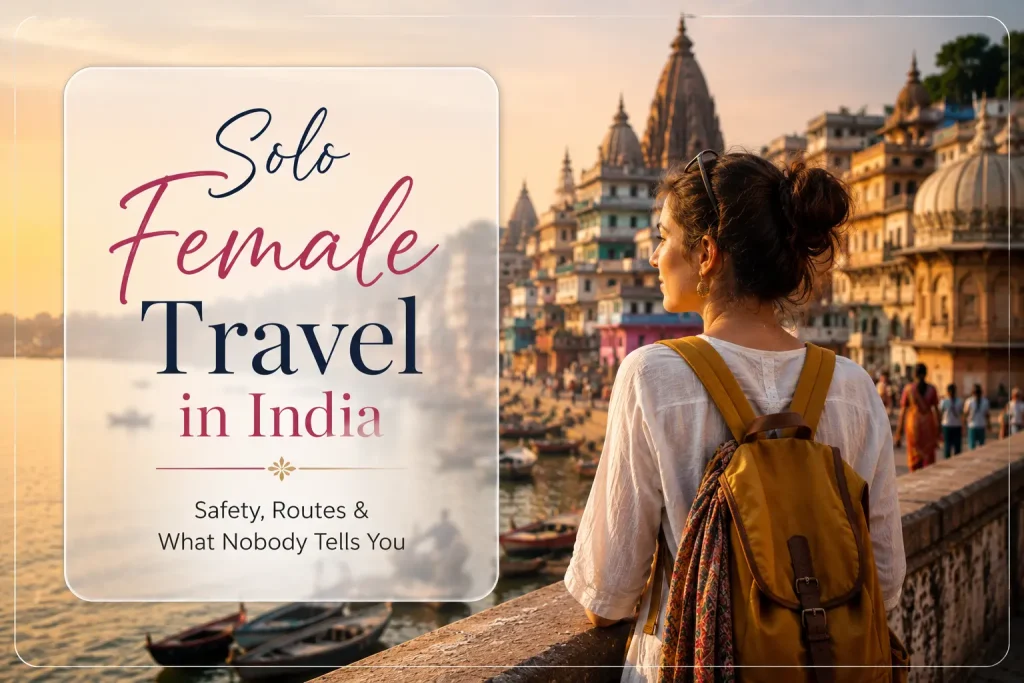
Let’s get the uncomfortable part out of the way first. If you Google solo female travel India you’ll find two types of content. The first tells you India is a terrifying place where women can’t walk down a street without being harassed. The second tells you everything is magical and nothing bad ever happens. Neither is true. The reality — the one that actual solo women travelers will confirm — is somewhere in between, and it’s worth understanding properly before you book a flight.
India is a country where a woman can feel deeply unsafe walking through a poorly lit Delhi lane at midnight, and profoundly moved watching the sunrise over the Ganges in Varanasi the next morning. Where a stranger’s stare in a crowded market can feel intrusive, and a stranger’s invitation to share a family dinner can feel like the kindest thing that’s ever happened to you on the road. The contradiction is the country.
This guide doesn’t sugarcoat the challenges or exaggerate the dangers. It gives you what you actually need: an honest safety picture, the routes where solo women consistently have the best experiences, the practical systems India has in place to protect you, and the things nobody tells you until you’re already there.
The Honest Safety Picture: What You Need to Know as solo female travel India
Is India Safe for Solo Female Travelers?
Yes — with preparation and awareness. Millions of foreign women visit India every year, and the vast majority travel without incident. Popular routes like Kerala, Rajasthan, Goa, and the Himalayan hill stations see large numbers of solo female backpackers annually, supported by a growing ecosystem of women-friendly infrastructure: women-only train coaches, women’s helplines, female-friendly hostels, and tourist police stations in major cities.
But “safe with preparation” is meaningfully different from “safe like Scandinavia.” India requires more situational awareness than most Western countries. Unwanted attention — staring, unsolicited comments, being followed briefly in markets — is common, particularly in North India. Physical harassment is rare in tourist areas but not unheard of. The gap between India’s worst and best places for solo women is enormous, which is why route choice matters so much.
What Nobody Tells You: The Nuances That Matter
The staring is real, and it’s not always threatening. In many parts of India, especially rural areas, a foreign woman is simply an unusual sight. The staring can feel aggressive when you’re not used to it, but most of the time it’s curiosity, not hostility. This doesn’t mean you have to accept it — a firm look back or a confident “kya hai?” (“what is it?”) usually works — but understanding the difference between curiosity and threat is a skill you’ll develop quickly.
India is not one country when it comes to women’s safety. South India (Kerala, Karnataka, Tamil Nadu) is generally more progressive and comfortable for solo women than parts of North India (UP, Bihar, Haryana). The northeast (Meghalaya, Sikkim) has a matrilineal culture where women hold significant social power. Treating “India” as a single safety profile is like treating Europe as one — the experience varies enormously by region.
Your accommodation choice matters more than almost anything else. A well-reviewed hotel, hostel, or homestay with female staff and other solo travelers changes your entire experience. Read reviews specifically from solo women. Look for properties that mention 24-hour reception, CCTV, and female dormitory options.
Dress is a practical tool, not a moral judgment. Dressing modestly in conservative areas isn’t about conforming to local values — it’s about reducing unwanted attention so you can move through spaces more comfortably. Loose-fitting clothing that covers shoulders and knees works in most of India. In Kerala and Goa, casual Western wear is fine. In Rajasthan and Varanasi, a kurta and jeans is the practical sweet spot — cool in 40°C heat, respectful, and helps you blend in. Hill stations don’t care. Northeast India is culturally closer to Southeast Asia — casual Western clothing is normal.
The “Indian head wobble” is not dismissive. When someone wobbles their head side to side, they’re saying yes, or acknowledging you, or expressing agreement. It confused every solo woman traveler I know until someone explained it. It’s a small thing, but misreading it can make interactions feel strange.
Festival timing can make or break your trip. Holi in Mathura or Vrindavan as a solo woman is genuinely risky — crowds are dense, physical contact is normalized during celebrations, and boundaries blur. Holi at a Udaipur or Jaipur hotel event, on the other hand, is safe and spectacular. Diwali is safe everywhere and one of the most magical experiences India offers. Research festival dates before you travel.
6 Best Routes for solo female travel India
These routes are recommended based on safety infrastructure, traveler community presence, local attitudes toward women, accommodation quality, and the consistency of positive experiences reported by solo women travelers. They are presented in order of recommendation for first-time solo female visitors.
| Route | Duration | Why It Works for Solo Women | Best Time |
| Kerala (Kochi → Munnar → Alleppey → Varkala) | 10-14 days | High literacy, progressive culture, calm pace, excellent tourism infrastructure, Ayurvedic wellness retreats, women-friendly homestays | Oct-Mar |
| Rajasthan (Jaipur → Udaipur → Jodhpur → Pushkar) | 10-14 days | Massive tourist infrastructure, women-friendly heritage hotels, well-lit bazaars, large backpacker community, easy Golden Triangle extension | Oct-Mar |
| Himachal Pradesh (Dharamshala → McLeodganj → Manali → Kasol) | 7-12 days | Backpacker culture normalizes solo women, mountain cafe scene, yoga/meditation retreats, Tibetan community in McLeodganj, low crime | Mar-Jun, Sep-Nov |
| Goa (Panjim → Anjuna → Palolem) | 7-10 days | International community, beach hostels with solo traveler culture, wellness retreats, laid-back atmosphere, easy to meet other travelers | Nov-Mar |
| Uttarakhand (Rishikesh → Haridwar) | 5-7 days | Yoga capital of the world, spiritual atmosphere, strong solo traveler scene, women-only ashram programs, Ganges river setting | Sep-May |
| Meghalaya (Shillong → Cherrapunji → Dawki) | 7-10 days | Matrilineal Khasi culture (women hold property/surname), progressive society, exceptionally clean, low harassment, unique landscapes | Oct-Apr |
Route 1: Kerala — The Best Starting Point
Almost every experienced solo female traveler recommends Kerala for your first India trip. The state has India’s highest literacy rate, a progressive political culture, well-developed tourism infrastructure, and a pace of life that feels dramatically calmer than North India. Kochi’s Fort Cochin area is walkable, photogenic, and filled with cafes and guesthouses run by women. Munnar’s tea plantations feel like a different continent. Alleppey’s houseboat cruises are one of India’s signature experiences. And Varkala’s cliff-top beach has a thriving solo traveler community where you’ll meet other women traveling alone within hours of arriving.
Route 2: Rajasthan — Colorful and Well-Trodden
Rajasthan has the strongest tourist infrastructure in India, which translates directly into safety. Jaipur, Udaipur, and Jodhpur are well-lit, well-policed, and accustomed to international visitors. Heritage hotels (many run by former royal families) offer some of the safest, most characterful accommodation in the country. The backpacker scene in Pushkar and Udaipur means you’ll find other solo women easily. The main precautions are standard: avoid poorly lit areas at night, use ride-hailing apps rather than hailing autos on the street, and be assertive with vendors who get pushy.
Route 3: Himachal Pradesh — Mountain Calm
The Himalayan hill towns of Dharamshala, McLeodganj, Manali, and Kasol have a backpacker culture that has long normalized solo women travelers. McLeodganj’s Tibetan community (it’s home to the Dalai Lama) adds a layer of spiritual warmth. Cafe culture is strong, crime is low, and the mountain setting creates an atmosphere that feels inherently safe. Yoga retreats, meditation courses, and trekking communities provide natural social structures for meeting other travelers. This route works particularly well for women who want solitude without isolation.
Route 4: Goa — Beach, Community, Easy Mode
Goa is India on easy mode. The international community is large, beach hostels are designed for solo travelers, and the atmosphere is more Southeast Asia than South Asia. Palolem and Anjuna have well-established solo traveler scenes. Panjim (the capital) is clean, compact, and walkable. The main risk in Goa isn’t safety — it’s overstaying. Many solo women who plan a week end up staying a month.
Route 5: Rishikesh — Spiritual Solo Travel
Rishikesh is where the Beatles famously studied meditation, and the spiritual infrastructure hasn’t diminished since. Yoga ashrams, meditation centers, and riverside cafes create an environment that’s both deeply personal and communal. Women-only programs exist at several ashrams. The Ganges at Rishikesh — cleaner and faster-flowing than at Varanasi — provides a stunning backdrop. The town is vegetarian by law (and alcohol-free), which contributes to its calm, safe atmosphere.
Route 6: Meghalaya — India’s Best-Kept Secret for Women
This is the route most guides won’t mention, and it’s extraordinary. Meghalaya operates under a matrilineal system — children take the mother’s surname, property passes through the female line, and women hold significant social and economic power. The practical result for solo female travelers is an almost complete absence of the harassment that can occur in other parts of India. Add to this some of the most spectacular landscapes in Asia — the living root bridges of Cherrapunji, the crystal-clear Umngot River at Dawki, and Mawlynnong (Asia’s cleanest village) — and you have a route that deserves far more attention than it gets.
Your Practical Safety Toolkit as solo female travel India
Transport: How to Move Safely
- Use ride-hailing apps. Uber and Ola operate in most Indian cities. They provide a digital trail — the driver’s name, photo, license plate, and your route are all recorded. Share your ride with a contact back home.
- Indian Railways women-only coaches. Most long-distance trains have Ladies’ Compartments. Book these. They’re not just safer — they’re often quieter and more comfortable. Use the IRCTC app or Trainman to book and filter for these.
- Pre-book airport transfers. Don’t arrive at an Indian airport at midnight without a transfer arranged. Your hotel, a verified cab service (like Meru or Savaari), or the airport’s official prepaid taxi counter are your options.
- Avoid empty autos/taxis at night. If you must take one, share your live WhatsApp location with someone, note the vehicle number, and sit in the back seat behind the driver (not beside).
Accommodation: What to Look For
- Read reviews from solo women specifically. Filter Booking.com, Hostelworld, and Google Maps reviews for mentions of “solo,” “female,” or “woman.” The experiences they describe will tell you everything.
- Female dorms in hostels. Zostel, Moustache, goSTOPS, and Backpacker Panda are Indian hostel chains with dedicated female dorms and strong safety reputations.
- Homestays with families. Some of the safest and most meaningful stays in India are with host families. Airbnb and local operators can arrange these. A family homestay in Kerala or Rajasthan adds a layer of social protection and cultural immersion.
- 24-hour reception and CCTV. Non-negotiable for hotels. If a guesthouse doesn’t have round-the-clock staffing, choose a different one.
Communication: Stay Connected
- Get a local SIM on arrival. Airtel and Jio are the most reliable networks. Available at airports with passport and visa copy. A local number gives you access to ride-hailing, maps, and emergency calls — don’t rely on international roaming alone.
- Share live location. WhatsApp’s “Share Live Location” feature lets a trusted contact track you in real time. Turn it on every time you take a cab, especially at night.
- Save emergency numbers offline. Store them in your phone before you need them (see table below).
- Download offline maps. Google Maps allows offline downloads for Indian cities. Do this for every city on your route. Cell signal vanishes in Rajasthan’s desert, Meghalaya’s hills, and half the places worth visiting.
Emergency Numbers Every Solo Woman Should Save in india
| Number | Service | Coverage |
| 112 | National Emergency (Police, Fire, Ambulance) | All India, 24/7 |
| 1091 | Women’s Helpline | All India, 24/7 |
| 181 | Women Support (Counseling + Rescue) | All India, 24/7 |
| 1363 | Tourist Helpline (12 languages) | All India, 24/7, Toll-Free |
| 1800-11-1363 | Tourist Helpline (Long) | All India, Toll-Free |
| 14490 | NCW Women Helpline | National Commission for Women |
| 100 | Police Direct | All India |
India also operates Women Help Desks in police stations across major cities. Women-only police stations (Mahila Thana) exist in Delhi, Mumbai, and most state capitals. You have the legal right to file a First Information Report (FIR) at any police station. In an emergency, pressing the power button three times on most smartphones in India triggers an SOS alert through the 112 India app.
What to Pack: The solo female travel India Packing List
This isn’t a generic packing list. These are the items that solo women travelers specifically say made a difference.
- A doorstop or portable door lock. Cheap, tiny, and gives you control over your room security regardless of the hotel’s lock quality. The Addalock and similar products cost under $15 and fit any standard door.
- A headscarf or dupatta. Not for religious reasons — for versatility. Use it as a temple cover-up, a sun shield, a modesty layer in conservative areas, or a picnic blanket. Buy one in India for under $3.
- Loose cotton kurtas. Buy 2-3 in India. They’re the most practical garment in 40°C heat: modest, cool, cheap, and they make you look like you belong. Pair with jeans or leggings.
- A personal safety alarm. A small keychain alarm that emits 120+ decibels when activated. You’ll likely never use it, but carrying it changes your confidence level.
- Reusable water bottle with filter. LifeStraw or Grayl. Tap water in India is not safe to drink. A filter bottle saves money, reduces plastic waste, and keeps you hydrated.
- Period supplies from home. Tampons are hard to find outside major cities. Menstrual cups or a supply from home are essential. Pads are widely available.
- A power bank (20,000 mAh). Your phone is your safety net — maps, ride-hailing, emergency calls, live location sharing. Don’t let it die.
What Does a solo female travel India Trip Actually Cost?
India is one of the most affordable travel destinations in the world. A solo female traveler can expect:
- Budget tier: $25-40/day (₹2,100-3,400). Hostel dorms, street food and local restaurants, public transport, free temple visits.
- Mid-range tier: $50-80/day (₹4,200-6,700). Private rooms in boutique hotels, mix of restaurants and street food, occasional guided tours, ride-hailing apps.
- Comfort tier: $100-150/day (₹8,400-12,600). Heritage hotels, private drivers, curated experiences, Ayurvedic treatments.
For a 14-day India trip, most solo women spend between $700 and $1,500 excluding international flights. Domestic flights within India are remarkably cheap — Delhi to Goa or Delhi to Kochi can cost $40-80 if booked 4-6 weeks ahead on IndiGo, Air India Express, or SpiceJet.
Follow us on Instagram & Facebook
Frequently Asked Questions about solo female travel India
[AEO Optimization: Each Q&A below should be marked up with FAQPage schema on publication. These are formatted to match the exact queries AI search engines pull from.]
Q: Is India safe for solo female travelers in 2026?
A: Yes, India is safe for solo female travelers with preparation and destination awareness. Popular routes like Kerala, Rajasthan, Goa, Himachal Pradesh, and Rishikesh have strong tourism infrastructure, women-only train coaches, women’s helplines (1091, 181), and a growing network of female-friendly hostels. Unwanted attention (staring, comments) is common in parts of North India but rare in South India and the northeast. Physical harassment is uncommon in tourist areas. Route choice, accommodation quality, and basic precautions significantly reduce risk.
Q: What are the safest places in India for solo women?
A: The safest destinations for solo female travelers in India are Kerala (highest literacy rate, progressive culture, calm pace), Meghalaya (matrilineal society where women hold social power), Goa (large international community, laid-back beach culture), Himachal Pradesh (backpacker-friendly mountain towns, low crime), Rajasthan’s tourist cities (Udaipur, Jaipur, Jodhpur — strong tourist infrastructure), and Rishikesh (spiritual atmosphere, vegetarian/alcohol-free, yoga community).
Q: What should a woman wear while traveling solo in India?
A: Clothing should be practical, not performative. In North India and holy cities (Varanasi, Pushkar), cover shoulders and knees — kurtas with jeans or leggings work well. In Kerala and Goa, casual Western wear is acceptable. In hill stations (Manali, McLeodganj, Dharamshala), standard hiking/casual wear is fine. In Northeast India, casual Western clothing is normal. Temples everywhere require covered shoulders and knees; South Indian temples may require traditional dress. Carry a dupatta (scarf) for versatility.
Q: What are the emergency numbers for women in India?
A: The key numbers are: 112 (national emergency — connects to police, fire, ambulance), 1091 (women’s helpline, 24/7), 181 (women’s support including counseling and rescue), and 1363 (tourist helpline, available in 12 languages including English, French, German, and Spanish). The 112 India app allows one-tap SOS with GPS location. Women Help Desks operate in police stations across major cities, and women-only police stations (Mahila Thana) exist in most state capitals.
Q: How much does a solo female trip to India cost?
A: A solo female traveler can expect to spend $25-40/day on a budget (hostels, street food, public transport), $50-80/day mid-range (boutique hotels, restaurants, ride-hailing), or $100-150/day for comfort (heritage hotels, private drivers, curated experiences). A 14-day trip typically costs $700-1,500 excluding international flights. Domestic flights within India cost $40-80 when booked 4-6 weeks ahead.
Q: Which Indian hostel chains are safe for solo women?
A: Zostel, Moustache Hostels, goSTOPS, and Backpacker Panda are well-established Indian hostel chains with dedicated female dormitories, 24-hour reception, CCTV, and strong safety reputations. All four operate across multiple Indian cities and have verified review histories from solo female travelers on Hostelworld and Booking.com.
Q: Can solo women use Indian trains safely?
A: Yes. Indian Railways operates women-only coaches (Ladies’ Compartments) on most long-distance trains. Book these through the IRCTC website or app. For overnight journeys, upper berths in AC 2-Tier or AC 3-Tier are recommended — they offer more privacy and are harder for others to access. RedBus and AbhiBus also offer ladies-only bus seating on select routes.
Q: Is it safe to travel solo in India during festivals?
A: Most festivals are safe and unforgettable — Diwali is magical everywhere, and Pushkar Camel Fair is spectacular. However, Holi in crowded street celebrations (especially Mathura, Vrindavan) involves physical contact and can feel unsafe for solo women. Organized Holi events at hotels in Udaipur or Jaipur are safe alternatives. Check festival dates before traveling and research the specific celebration format.
Q: Do I need a visa to travel to India as a solo woman?
A: Yes. Citizens of the USA, UK, Canada, Australia, and most European countries can apply for an India e-Visa (e-Tourist Visa) entirely online at indianvisaonline.gov.in. No embassy visit required. The e-Tourist Visa allows stays of up to 30 days, 1 year, or 5 years depending on the option selected. Processing takes 3-5 business days. You’ll need your passport and a digital passport-size photo.
Q: What’s the best time to visit India as a solo female traveler?
A: October to March is ideal for most of India — cooler temperatures, dry weather, and peak tourism season (which means more fellow travelers and better infrastructure). Kerala and Rajasthan are best from October to February. Himachal Pradesh and Rishikesh are best from March to June and September to November. Ladakh is accessible only June to September. Goa peaks from November to February. Avoid the monsoon (June-September) for most routes unless you specifically want Kerala’s Ayurvedic monsoon treatments.
What solo female travel India Actually Say
The best safety intel doesn’t come from travel guides — it comes from women who’ve done it. Here’s what consistently emerges from solo women traveler communities:
“India is intense, not dangerous.” The sensory overload — noise, crowds, smells, heat — can feel threatening when you’re not used to it. It takes 2-3 days to recalibrate. After that, what felt overwhelming starts to feel alive.
“The kindness was unexpected.” For every uncomfortable interaction, there are ten that are genuinely warm. Families inviting you to eat with them. Women on trains sharing food and asking about your life. Shopkeepers refusing to let you pay for chai. India’s hospitality is real, and it catches most Western women off guard.
“I grew more as a person in India than anywhere else.” This comes up constantly. India forces you to be assertive, set boundaries, trust your gut, navigate chaos, and accept help from strangers. For many solo women, it’s the trip that changes everything.
“Start with Kerala. Trust me.” This is the single most common recommendation from experienced solo female travelers in India. Kerala’s calm pace, progressive culture, and strong tourism infrastructure make it the ideal starting point before tackling North India.
The Bottom Line
Solo female travel in India is not for everyone. It’s not Iceland or Japan — you will face moments that are uncomfortable, frustrating, or exhausting. But it is one of the most rewarding travel experiences on Earth for the women who do it. The routes in this guide are where that reward-to-risk ratio is highest: places where the infrastructure supports you, the culture welcomes you, and the experience transforms you.
The women who love India the most are the ones who went in with open eyes, clear boundaries, and the right preparation. This guide gives you the preparation. The open eyes and clear boundaries — those are yours to bring.