Why Hornbill Festival is celebrated comes down to one central purpose: giving Nagaland’s many Naga communities a shared platform to preserve, perform, and present their distinct traditions, while giving visitors a chance to encounter that diversity in one place. Held each December at Kisama Heritage Village near Kohima, the festival brings together music, dance, textiles, food, and craftsmanship from across the state. It is not a single uniform display of “tribal culture,” but a coordinated gathering of distinct community traditions, organized to encourage cultural exchange between Naga communities and with visitors from India and abroad.
What Is the Hornbill Festival?
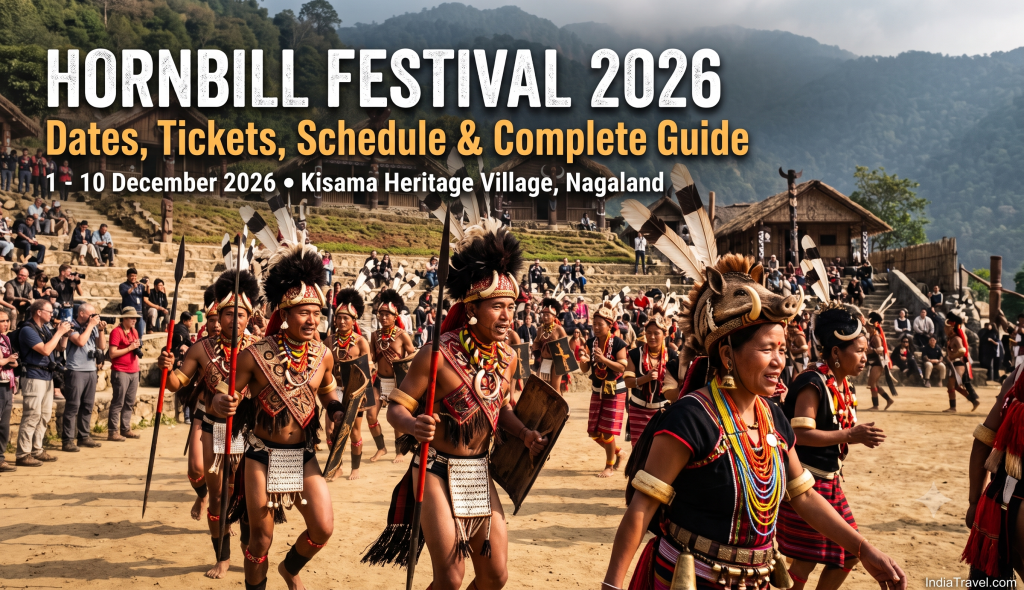
The Hornbill Festival is an annual ten-day cultural event held at Kisama Heritage Village near Kohima, Nagaland, where the state’s Naga communities present traditional music, dance, clothing, food, and crafts on a shared platform organized by the state government.
The festival brings community-specific traditions, normally celebrated separately within individual villages, into a single setting over a fixed period each December. It gives Naga communities a coordinated opportunity to display their distinct practices side by side, and gives domestic and international visitors a way to encounter this diversity without traveling to dozens of individual villages. Over time, it has become central to Nagaland’s cultural tourism, drawing attention to a part of India that receives comparatively few international visitors relative to its cultural depth.
Why Is Hornbill Festival Celebrated?
Hornbill Festival is celebrated to showcase, preserve, and promote Nagaland’s diverse cultural traditions on a shared platform. It brings Naga communities together to present their music, dance, clothing, food, and crafts, supports cultural continuity for younger generations, and introduces visitors to Nagaland’s cultural life beyond generalized ideas about Northeast India.
Preserving Cultural Traditionsc
Many Naga communities maintain oral histories, folk songs, dance forms, weaving techniques, and culinary practices passed down within families and villages. The festival gives these traditions a public stage, which can support their continued practice by younger community members who might otherwise have fewer occasions to perform or display them outside their own village context.
Bringing Naga Communities Together
Nagaland is home to more than a dozen recognized Naga communities, each historically organizing its own festivals and ceremonial calendar. Hornbill does not merge these into one identity; instead, it creates a shared calendar event where each community presents its own practices, often from its own designated pavilion or morung (traditional community house), while acknowledging that customs and histories differ between groups.
Sharing Nagaland’s Culture With Visitors
For visitors, especially those unfamiliar with Northeast India, the festival offers direct exposure to living Naga traditions rather than secondhand descriptions. This matters because Nagaland’s communities are often reduced to brief or outdated characterizations in general travel writing; seeing performances, textiles, and food firsthand gives a more accurate picture.
Supporting Cultural Tourism
The festival creates a seasonal opportunity for local artisans, performers, guides, and food producers to present and sell their work directly to visitors. This does not represent a transformation of the local economy on its own, but it does give community members a direct channel to visitors interested in their craft and traditions.
History of the Hornbill Festival
The history of Hornbill Festival begins in 2000, when the Government of Nagaland established it to bring the state’s individual community festivals under a shared calendar event and to support tourism. Before this, each Naga community celebrated its own harvest and ceremonial festivals separately, largely within its own village or region.
It is important to distinguish between the festival itself, a modern institution created in 2000, and the much older community traditions it showcases, some practiced for generations. The festival did not invent Naga culture; it created a new, shared occasion for communities to present traditions that already existed. Since its founding, the festival’s scale, programming, and international visibility have grown considerably, expanding to include contemporary elements such as a rock music festival alongside traditional programming.
Why Is It Called the Hornbill Festival?
The festival takes its name from the hornbill, a large forest bird that appears in the folklore of many Naga communities and has historically been associated with qualities such as alertness, strength, and beauty. Hornbill feathers have traditionally been used in ceremonial headgear among several communities, and the bird’s image appears in aspects of traditional art and craft.
Not every Naga community holds an identical relationship with the hornbill, and its specific symbolic meaning can vary between communities. What is broadly shared is recognition of the hornbill as a culturally significant species across much of Nagaland, which is why it was chosen to represent a festival intended to unite the state’s communities under one name. The Great Hornbill is now a species of conservation concern in the region, a point Nagaland’s tourism and conservation bodies have increasingly highlighted alongside the festival.
Why Is Hornbill Known as the “Festival of Festivals”?
Hornbill is often called the “Festival of Festivals” because it consolidates what would otherwise be many separate, community-specific celebrations into a single ten-day event. Rather than requiring a visitor to travel to individual villages across Nagaland at different times of year to see distinct traditions, Hornbill brings representative performances, food, and crafts from these communities into one venue and timeframe.
This description should not be read as suggesting the festival substitutes for visiting individual communities or villages. It offers a concentrated introduction to Nagaland’s cultural range, not a replacement for the deeper, ongoing traditions that continue in villages throughout the year.
Cultural Significance of the Hornbill Festival
The significance of Hornbill Festival lies in its role supporting cultural identity and intergenerational transmission of traditional knowledge. Dance forms, music, weaving patterns, and oral storytelling are actively performed and observed at the festival rather than treated as historical artifacts. Community participation, including elders and younger performers appearing together, reflects how these traditions continue to be practiced rather than only remembered.
Textiles and clothing displayed at the festival often carry meaning specific to a community, such as marking achievement, status, or lineage. Handicrafts, including woodwork, cane and bamboo items, and metalwork, represent skills maintained across generations. Food traditions, including smoked meats, fermented preparations, and locally brewed rice beer, reflect regional agricultural and culinary practices. Indigenous games and sport, including Naga wrestling and archery, are presented as living activity rather than performance for tourists.
Culture at the festival is best understood as ongoing and evolving, rather than something frozen for display.
Naga Communities and Cultural Diversity
International visitors should understand that “Naga culture” is not a single, uniform set of customs. Nagaland’s recognized Naga communities differ in language, traditional clothing, festival calendars, music, dance styles, cuisine, and craft traditions. Some practices are shared or similar between neighboring communities, while others are specific to a single group.
The Hornbill Festival provides a shared platform without erasing these distinctions. Each community typically presents its own pavilion, performance slot, or morung representation, allowing visitors to notice differences in dress, instruments, and custom rather than assuming a single generalized “tribal” identity applies across the state.
What Happens at the Hornbill Festival?
Programming changes from year to year, but certain categories of activity are consistently part of the festival.
Traditional Dance and Music
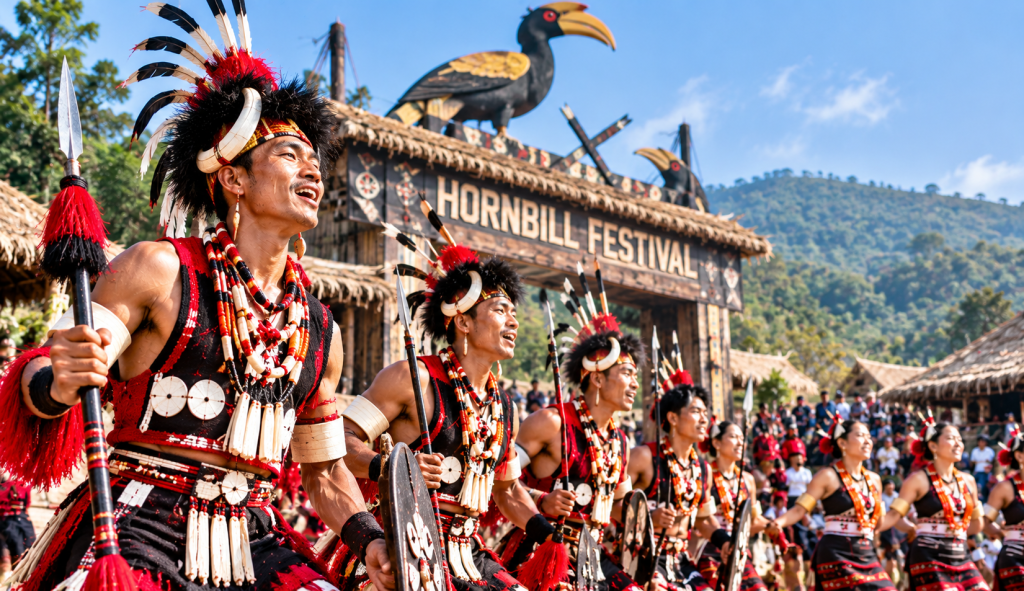
Community groups perform dances and songs, often accompanied by traditional instruments such as log drums, tied to specific histories.
Traditional Clothing and Textiles
Ceremonial shawls, beadwork, and headgear vary by community and often carry meaning beyond decoration.
Local Food
Food stalls offer regional dishes, including smoked meats, bamboo shoot preparations, and fermented rice beer associated with several communities.
Handicrafts and Handloom
Weaving, woodwork, and bamboo craftsmanship are demonstrated and sold directly by artisans.
Indigenous Games and Sports
Naga wrestling, archery, and other traditional contests are held at designated grounds.
Music and Contemporary Culture
Alongside traditional programming, the festival now includes contemporary music events, including a rock music festival component.
Cultural Demonstrations and Community Spaces
Morungs and pavilions representing individual communities give visitors informal opportunities to see craft demonstrations and ask questions directly.
Why Is Hornbill Festival Famous?
Why is Hornbill Festival famous has less to do with any single spectacular claim and more to do with the concentration of genuine cultural variety it offers in one accessible setting. Visitors encounter multiple community traditions, distinctive music and dance, direct access to craftspeople, and regional food, all within a defined festival ground, set within Northeast India’s distinctive hill geography. For photographers and cultural travelers, this combination of accessibility and cultural depth is uncommon within India’s broader festival calendar.
What Can International Tourists Learn From the Hornbill Festival?
For travelers from the United States, United Kingdom, Canada, Australia, and Europe, the festival offers a chance to understand Northeast India’s place within India’s broader cultural landscape, which differs meaningfully from the regions most international visitors typically see. It shows that cultural diversity within India extends to language, dress, and custom even within a single small state. Observing craftsmanship, food preparation, and performance directly, rather than through summarized description, supports a more accurate understanding of Naga communities as active participants in their own cultural presentation, not subjects on display for outside observation.
How to Experience the Hornbill Festival Responsibly
Ask permission before taking close-up photographs of performers or community members, and accept a refusal without argument. Respect performances and ceremonies by not interrupting them for photographs or requests. Traditional clothing carries specific meaning and should not be treated as a costume prop or worn without understanding its significance. When uncertain about a cultural object or practice, ask rather than assume. Purchase handicrafts directly from artisans where possible, follow posted local rules, respect religious and community spaces, and dispose of waste responsibly.
Is Hornbill Festival Worth Visiting for International Travelers?
For travelers interested in culture, festivals, photography, music, food, and craftsmanship, Hornbill offers a rewarding introduction to Naga communities and Northeast India. It suits community-based and cultural travel rather than conventional sightseeing. That said, Nagaland requires more travel planning than India’s more established tourism circuits, including domestic connections, current entry requirements for foreign nationals, and December’s cooler hill weather. Travelers prepared for that planning tend to find the experience worthwhile.
Planning a Trip to Experience Hornbill Festival Nagaland
Most visitors base themselves in Kohima and travel out to Kisama Heritage Village for festival events. Given December’s high demand locally, advance accommodation booking is worth prioritizing. Transport typically involves a domestic connection toward Northeast India followed by a road journey to Kohima, and current entry requirements for foreign nationals should be confirmed with official sources before travel, since permit rules for Nagaland have changed in recent years. Some travelers also combine the festival with other Northeast India destinations given the distance involved.
International travelers who would prefer help arranging transport, accommodation, and a broader Northeast India itinerary can explore our Hornbill Festival Tour, which is built specifically around this festival and the surrounding region.
FAQ Section
Why is Hornbill Festival celebrated?
Hornbill Festival is celebrated to give Nagaland’s Naga communities a shared platform to preserve, perform, and present their traditional music, dance, clothing, food, and crafts, while introducing visitors to the state’s cultural diversity beyond generalized ideas about Northeast India.
What is the Hornbill Festival?
It is an annual ten-day cultural event held at Kisama Heritage Village near Kohima, Nagaland, where the state’s Naga communities showcase traditional performances, textiles, food, and craftsmanship on a shared platform organized by the state government.
What is the history of Hornbill Festival?
The festival was established in 2000 by the Government of Nagaland to bring the state’s separate community festivals under one shared event and support tourism. It builds on much older Naga traditions rather than replacing them.
Why is it called the Hornbill Festival?
It is named after the hornbill, a large forest bird featured in the folklore of many Naga communities and historically associated with qualities such as alertness and beauty, with its feathers traditionally used in ceremonial headgear.
Why is Hornbill Festival famous?
It is known for concentrating a wide range of genuine cultural traditions, including music, dance, textiles, food, and craftsmanship from multiple Naga communities, into one accessible setting, making it a notable event within Northeast India’s cultural tourism.
Why is it called the Festival of Festivals?
The description reflects how Hornbill consolidates many separate, community-specific celebrations into a single ten-day event, letting visitors encounter representative traditions from multiple Naga communities without traveling to individual villages throughout the year.
Where is the Hornbill Festival celebrated?
The festival is held at Kisama Heritage Village, roughly 12 kilometers from Kohima, the capital of Nagaland, a state in Northeast India bordering Myanmar.
Can international tourists attend the Hornbill Festival?
Yes. International tourists regularly attend, though current entry requirements for foreign nationals visiting Nagaland should be confirmed with official sources, since permit rules for the state have changed in recent years.